


unboxing God and opening to mystery
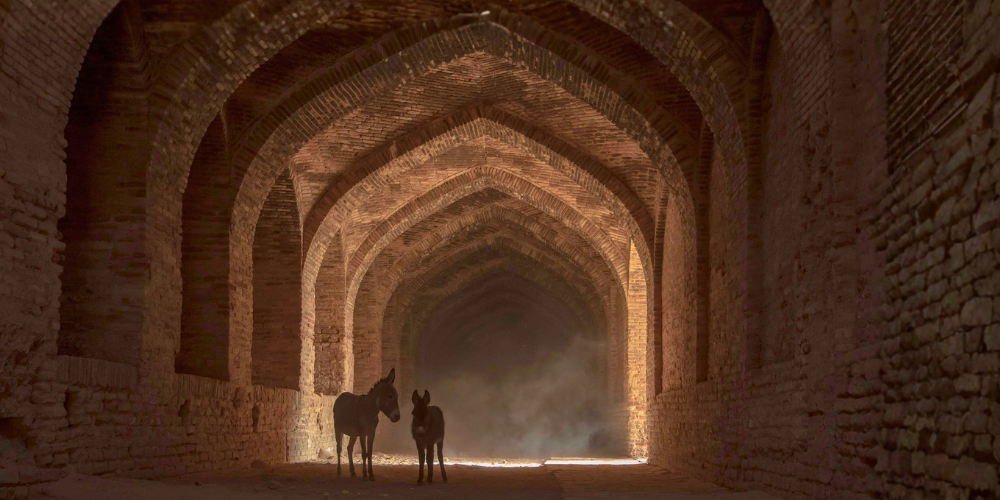
An old Sufi story about Mulla Nasrudin tells of how he took his donkey across a frontier every day, with the panniers loaded with straw.
Each night when he returned, Nasrudin admitted that he was a smuggler. And so the frontier guards searched him over and over again. They searched his person, sifted through the straw, even burned it from time to time. All the while, Nasrudin became visibly more and more prosperous. Then one day he retired and went to live in another country.
Years later, one of the customs officials met Nasrudin and asked him, ‘You can tell me now – what was it you were smuggling, when we could never catch you out?’ ‘Donkeys,’ said Nasrudin.
The guards and custom officials had some very fixed, very certain ideas about the sort of things smugglers get up to. And these prevented them from seeing what was right in front of their noses.
Overlooking God’s presence
Having strong ideas of how God should appear (perhaps as some sort of supernatural object, or spiritual vision or feeling) can cause us to overlook God’s presence, which is always manifesting in the fabric of our ordinary life – manifesting as our life. Seeking a for a certain fixed form, for something definite to grasp onto, we can miss the reality.
Those of you who came to the launch of our recent book The Missing Peace last November, might remember Bishop Rachel Treweek saying, ‘We live in a world where people are longing for certainty, because everything feels uncertain and people are anxious…and want certainty… And I think that one of the dangers for the church is that, in our desire to give people certainty, we try and rationalise everything. And I want to say, people are longing for mystery. Don’t try and box God.’
We live in a world which in so many ways teaches us to box things, to try and pin life down and hold on to it tightly.
But meditation (silent prayer) invites us to do something radically different. To un-box. To open to the mystery that will never be pinned down. To free-fall into our life in God.
Comprehending or apprehending?
In an interview about poetry as a door into mystery, the poet Malcolm Guite highlighted a distinction between comprehending and apprehending. ‘The idea of comprehend,’ he said, ‘is that you comprehend something by completely surrounding it, so that your mind completely understands it. ‘Apprehend is something else. When you apprehend something, you’re not saying you’ve completely got a hold of it, you’re saying you’ve grasped something of it, and are moving towards it.’
To paraphrase St. Augustine, if you are able to comprehend something, you may be sure that what you comprehended was not God. We cannot comprehend God. The infinite is always infinitely more than the finite mind can grasp. But God can be apprehended. We can know God truly without knowing God exhaustively.
‘Dwell in me,’ says Christ (John 15:4), not, ‘dwell in thoughts about me.’ Christ’s invitation is to dwell in the Ultimate Reality beyond all thoughts, to know the Truth beyond the grasp of the conceptualising mind.
Which is why the great Desert Father Evagrius describes prayer as the letting go of thoughts and concepts. (1)
Wisdom from the Desert Fathers and Mothers
‘Hold no intermediate image between the mind and the Lord when practising prayer,’ says Bishop Theophan the Recluse. The essential thing, he says, ‘is to dwell in God’ trusting that ‘God is in you, as He is in everything, and that this awareness ‘must not be accompanied by any visual concept.’ (2)
In meditation, we practice un-grasping, un-boxing.
Saying our prayer word, following our breath, we open to the mystery that will never be pinned down. We free-fall into our life in God. As we learn to release our thoughts about reality, we discover that what is left is reality. As we learn to release our thoughts about God, we discover that God is right here.
In the words of St. Symeon the New Theologian:
‘It is invisible, and no hand can lay hold of it;
Intangible, and yet it can be felt everywhere…
What is it? O wonder! What is it not? For it has no name
In my foolishness, I tried to grasp it,
And I closed my hand, thinking I could hold it fast:
But it escaped, I could not retain it in my fingers.
Full of sadness, I unclenched my grip
And I saw it once again in the palm of my hand.’ (3)
‘Do not grasp me,’ the resurrected Jesus says to Mary Magdalene (John 20:17). It is as if he is saying to her, and to us, ‘There is no need. Just open to my presence. I am holding you…’

This blog is based on one of the teachings given in a recent online meditation group gathering. You are warmly welcome to join one of our future gatherings.
We use cookies (including Google Analytics and Meta Pixel) to enhance your browsing experience, serve personalised ads or content, and analyse our traffic. By clicking ‘Accept All’, you consent to our use of cookies.