


Wisdom from Meister Eckhart & Thich Nhat Hanh
It is not unusual for us to receive messages from people who are new to the practice community saying that they have tried to meditate for years, but it’s only since they’ve been part of this group that they’ve been able to sustain a daily practice. The support and encouragement we receive in belonging to a practice community is a precious gift.
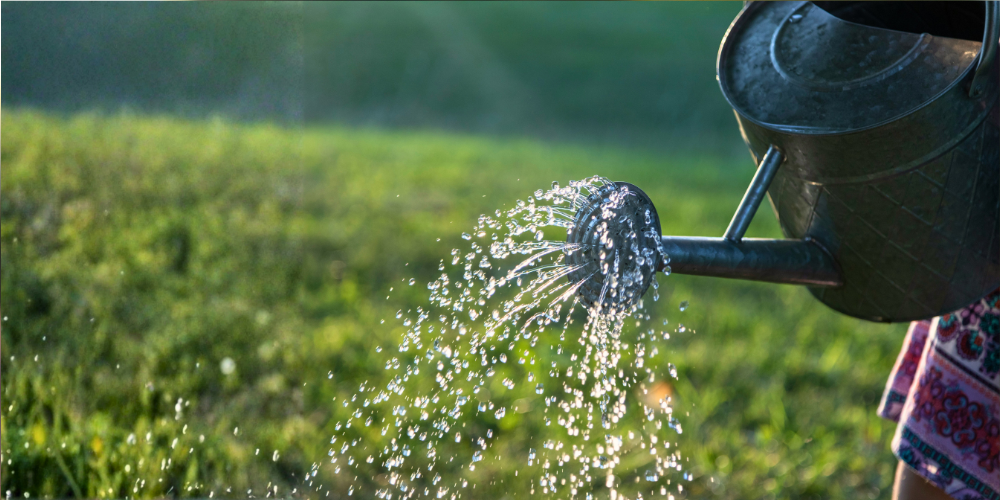
‘When you practice with others,’ says the Zen Buddhist teacher Thich Nhat Hanh, ‘it is much easier to obtain stability, joy, and freedom … sitting, walking, breathing, praying, and doing everything in mindfulness. The seeds are being watered, and the fruit, transformation, will reveal itself.’ (1)
‘God’s seed is in us,’ says the medieval Christian teacher Meister Eckhart. ‘If it were tended by a good gardener, it would grow up to God, whose seed it is, and its fruits would be like God’s own nature. The seed of a pear tree grows into a pear tree, the seed of a nut tree grows to be a nut tree, the seed of God grows to be God.’ (2)
Thich Nhat Hanh’s students affectionately called him ‘Thay,’ a Vietnamese word meaning ‘teacher.’ From this point on, I’ll refer to him as ‘Thay,’ because, like Eckhart, he has been an important teacher to me.
The seeds of transformation
How do we water the seeds of stability, joy and freedom within us? How do we become ‘a good gardener’ of the seed of God within us?
I’d like to touch on two great and closely related themes in the teaching of Eckhart and Thay: releasing and coming home. By learning to release, we come home to the present moment. We come home to our life, right here, right now. We come home to take care of the seeds of transformation, the seed of God within us, to become the likeness of God, which is peace, which is love. ‘Sitting, walking, breathing, praying,’ we cultivate space for deeper awareness – to listen for the whispers of grace within us, which we might otherwise overlook.
Coming home to the Now
Ultimately, meditation, like all prayer, is about relationship, communion; with God, with each other and with all creation. How do we open to this communion? How do we cultivate this space for deeper awareness, listen and respond to the whispers of grace within us? Both Eckhart and Thay say: ‘Practice being present. Practice being here.’
Meditation is often spoken of as a journey. Hearing it described as a journey we might imagine movement, travelling somewhere else – toward transformation, toward God. But when we listen carefully to the voices of the Christian contemplative tradition, meditation sounds less like a journey outward, to somewhere else, and more like a journey inward, a process of coming home. A return to what is already here. ‘All the future and the past are [here] in one Now,’ says Eckhart and prays, ‘that we may attain to this Now.’ (3)
In his book Living Buddha, Living Christ, Thay speaks very simply about what it means to practice coming home to the ‘now’ of our life. Again and again, he returns to one central insight: that peace, healing, and transformation are available only in the present moment. Because the present moment is the only place where life actually happens.
Thay speaks about our habit of postponing life – waiting until the conditions are right, until we are calmer, wiser, or more settled. The danger with this, says Thay, is that we miss our appointment with life. ‘Our appointment with life is in the present moment. The place of our appointment is right here, in this very place. (4) He gently exposes how easily we turn the future into an imagined refuge, while missing what is already given, what is always being given. Thought of in this light, we might describe meditation as the practice of learning to be present to what is present, to who is present, to all that is ceaselessly arriving.
Meister Eckhart would recognise this immediately. Although his language is very different, Eckhart insists just as strongly that God is not found elsewhere, through spiritual travel, accumulation, or delay. God is encountered in the depths of who we are, says Eckhart, as the ground of who we are. And both Eckhart and Thay teach that the place of encounter is not later, but now – and that we come home to this now when our minds are no longer scattered, when our attention is no longer divided and dispersed – when we are no longer absent from ourselves, our life, our home.
Releasing our grip
Historically, meditation has often been associated with renunciation. But Eckhart reframes renunciation in a striking way. What must be released is not pleasure, happiness, delight in all the good gifts of creation, but clinging. What must be released is the mind, the habit, that tries to cling to pleasure, to happiness, to the gifts of creation, while always reaching to grasp more.
Thay, like so many Christian teachers, speaks of stopping – stopping the habit of grasping, stopping the habit of running around in the belief that peace lies somewhere else, stopping the endless inner commentary that blinds us to what is right here. He draws directly on the Psalmist’s teaching, ‘Be still and know that I am God’ (Psalm 46:10), interpreting ‘be still’ as the calming and gathering of the mind, and ‘know’ as deep seeing.
For both Eckhart and Thay, stillness of mind is not passive, but active: open, receptive, attentive. Stillness is not a turning-away from life, but the condition that allows us to be fully present for life. When we are no longer divided, something begins to settle. And in that settling, a deeper awareness becomes possible.
Eckhart speaks of returning to the ground of the soul, the depthless-depth of our being, where God is always at work before we do anything at all – the ground ‘where God’s ground and the soul’s ground are one ground.’ (5) Thay speaks of touching our ‘true home’ in the present moment – not as an idea, but as a lived experience of being here, breathing, alive.
Again, with this in mind, we might see meditation as a process of homecoming. Not returning to a place, but a returning to presence. And in relation to this, Eckhart’s teaching on poverty of spirit is especially important. Poverty of spirit is not moral austerity. It is the willingness to be free of the inner noise that constantly fills every space with judgment, comparison, and expectation. It is the decluttered awareness that comes from the practice of releasing. Here Eckhart and Thay come remarkably close.
Thay speaks in similar terms when he warns against being trapped by views — even spiritual ones. ‘No view can ever be the [ultimate] truth. It is just from one point; that is why it is called a “point of view.” If we go to another point, we will see things differently and realise that our first view was not entirely right. Buddhism is not a collection of views. It is a practice to help us eliminate wrong views.’ (6)
Clinging to ideas, to beliefs and dogmas, can become serious obstacles to encounter. ‘Reality,’ says Thay, ‘is free from all notions.’ (7) ‘It is our duty to transcend words and concepts to be able to encounter reality.’ (8) He might have smiled to hear Eckhart say, ‘I pray to God to make me free of God, for my essential being is above God…’ (9) He prayed that God might free him from his ideas of God, so he could come home to God.
Learning to be present
In meditation, we set out on a journey like no other. Saying our prayer word, following our breath, we learn to travel lightly. Instead of packing, we unpack. We release the urge to be somewhere else. We release the urge to become someone else. We practice being right here, just as we are.
Instead of trying to grasp hold of what cannot be grasped, we allow ourselves to be held. We practice being present within the ever-present presence of God. Saying our prayer word, following our breath, we let go of our thoughts, of all that arises in our mind, and allow ourselves to come home.
What is most often spoken of as ‘attention,’ ‘awareness’ or ‘wakefulness’ by Christian teachers, is spoken of as ‘mindfulness’ by Thay. ‘Mindfulness is the key,’ he says:
‘When you become aware of something, you begin to have enlightenment. When you drink a glass of water and are aware that you are drinking a glass of water deeply with your whole being, enlightenment is there in its initial form.’ (10). ‘Mindfulness is the light that shows us the way.’ (11). Mindfulness, to be aware, to be awake in this moment, is to come home.
‘When you practice mindfulness,’ says Thay, ‘you enjoy within you the fruits of the practice. You are happy and peaceful, and your happiness and peace radiate around you for others to enjoy.’ (12) ‘Be peaceful within yourself,’ says St Isaac the Syrian, ‘and heaven and earth will be at peace with you.’ (13)
How do we listen for the whispers of grace within us?
By a process of letting go, says Eckhart, through releasing into the ‘now’ of our life, the ‘Now’ of God. ‘Sink away from your youness and dissolve into His Hisness,’ he says, ‘and your ‘yours’ and His ‘His’ should become … completely one Mine.’ (14) ‘Know Him without image, without means, and without semblance… God must really become I and I must really become God, so fully one that this ‘he’ and ‘I’ become and are one ‘is…’ (15).
What is left when we let go of all our thoughts about our life? Our life!
What is left when we let go of all our thoughts about God? God!
We arrive where we began, to discover we never left.

This blog is based on one of the teachings given in a recent online meditation group gathering. You are warmly welcome to join one of our future gatherings.
We use cookies (including Google Analytics and Meta Pixel) to enhance your browsing experience, serve personalised ads or content, and analyse our traffic. By clicking ‘Accept All’, you consent to our use of cookies.