

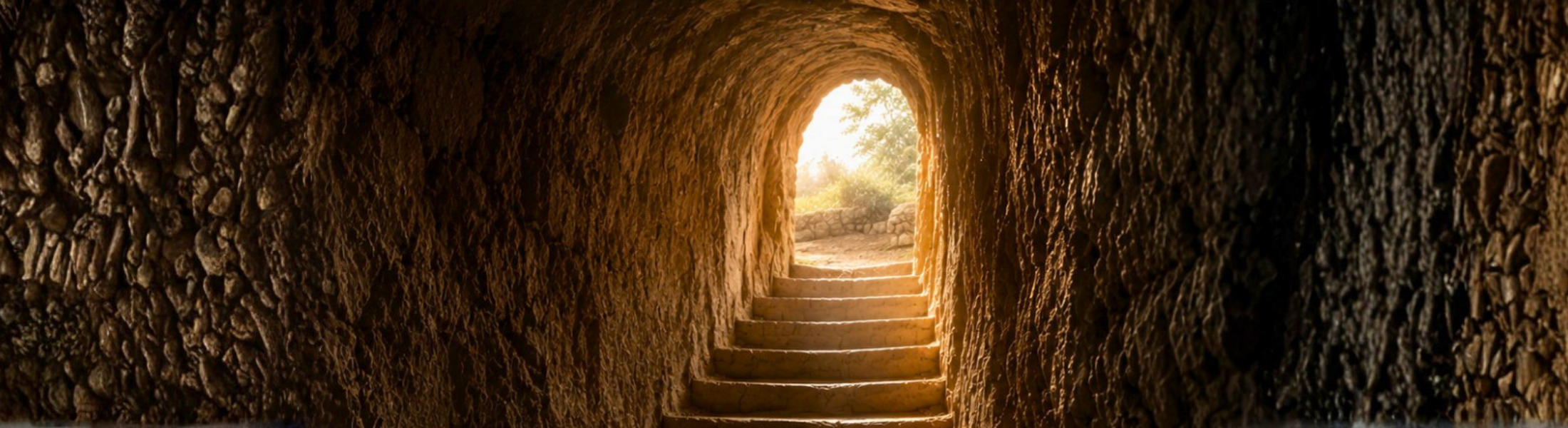





How might learning a new relationship with change and death liberate us from fear and help us to embrace and enjoy life more fully, at whatever stage of life we find ourselves?
We tend to think of death as the great interruption of life – something to be feared, resisted and, if possible, postponed for as long as we can. But early Christians thought of death and life in an astonishingly different way. They spoke of our present life as like being in a womb, a time of gestation and growth leading up to our birth.
On his way to martyrdom in Rome in the second century, St Ignatius of Antioch wrote to the Christians there, asking them not to try and prevent what he was facing, saying: ‘Birth-pangs are upon me…hinder me not from living…when I will have arrived there, I will be a human being.’
This early Christian perspective turns our contemporary understanding of life and death upside down. As far as Ignatius is concerned, he is not yet born, but about to be. He is not yet living, but coming into fulness of life. He is not losing his human life, but about to become a human being.
This is not a rejection of earthly life, nor a desire to escape from it. Rather, Ignatius is pointing towards a radically different understanding of what it means to be alive, what it means to die, and what it means to become a human being. Christ comes to free us, to liberate us, not from our mortality, but, as St Paul puts it, from ‘the fear of death’ that holds us in ‘lifelong bondage’ (Hebrews 2:14-15).
For the early Christians, the fear of death was not simply fear of the moment when our present life will come to an end, but a root cause of profound bondage, shaping our world, the whole way we live. Afraid of death, afraid of losing what we mistakenly think our life to be, we become trapped in fear. We seek to possess, to control, to defend and accumulate. We try to secure and cling to mortal life, which is inevitably passing away.
Christ does not conquer death simply by making it disappear. He transforms it for us from within. And in doing so, reveals both the nature of God as self-giving love and what it means to become a human being. When Pilate brings Jesus before the crowd and says, ‘Behold the human being’ (John 19:5), the truly human being is revealed as the one who gives themselves away in love. With all this in mind, we might hear Jesus’ paradoxical teaching in a new and profoundly liberating way: ‘Whoever wishes to save their life will lose it, but whoever loses their life for my sake will find it’ (Matthew 16:25). What so many of us think of as the end becomes the beginning.
How might this change the way we understand our own death – and so our life? Drawing on early Christian teachers and the recent writings of Professor John Behr, we will explore:
Following the workshop, all ticket holders will receive access to the recordings of Chris’ talks and be invited to an optional online discussion evening, where people can join small break-out groups of 5–6 people to continue exploring the ideas raised.
The event has been carefully crafted to be inclusive and accessible, welcoming anyone seeking truth, peace, and spiritual renewal, regardless of their faith, beliefs or previous experience of meditation.
The workshop will include a flow of two talks, times of conversation, a period of silent meditation and a break.
Following the workshop, all participants will receive access to recordings of Chris’ talks and be invited to an optional online discussion evening, where people can join small break-out groups of 5-6 people to continue exploring the ideas raised. Three dates will be offered and we’ll proceed with the most popular one.
Chris Whittington is the Founder of The School of Contemplative Life. He was introduced to contemplative practice during several years of formation when he lived at the Benedictine monastery of Prinknash Abbey in England. Chris’ monastic teachers taught meditation as a universal wisdom found within all the great spiritual traditions, a pathway to peace and solidarity with people of all faiths and none. Following an introduction by the Abbot of the Prinknash community, Chris subsequently studied at the Dalai Lama’s monastery in Dharamshala, India.
Chris regularly delivers talks, workshops and retreats and has introduced the practice of meditation in the Christian tradition to thousands of people in the UK and abroad. He is known for his ability to communicate the subtleties of the practice and complex spiritual texts in simple, practical ways, resonant with the challenges of daily life.
Chris is the author of The Missing Peace – Meditation as a Spiritual Path to Peace, Community and Oneness published by Canterbury Press.
Events organised by The School of Contemplative Life are subject to our Event Terms & Conditions (available in full here). Where an event is organised and hosted by a third party, their own terms and conditions apply.
Please note: our events and those we contribute to or lead on behalf of a third party should be understood as providing spiritual guidance and advice to help participants deepen their own meditation practice and understanding. If you have any mental, emotional or physical health conditions, please ask your medical practitioner if it is advisable for you to attend and make sure you always follow your medical practitioner’s advice.
All Bursary applications are administered by The School of Contemplative Life in accordance with our Bursary Guidelines.
We use cookies (including Google Analytics and Meta Pixel) to enhance your browsing experience, serve personalised ads or content, and analyse our traffic. By clicking ‘Accept All’, you consent to our use of cookies.