


A love letter from God
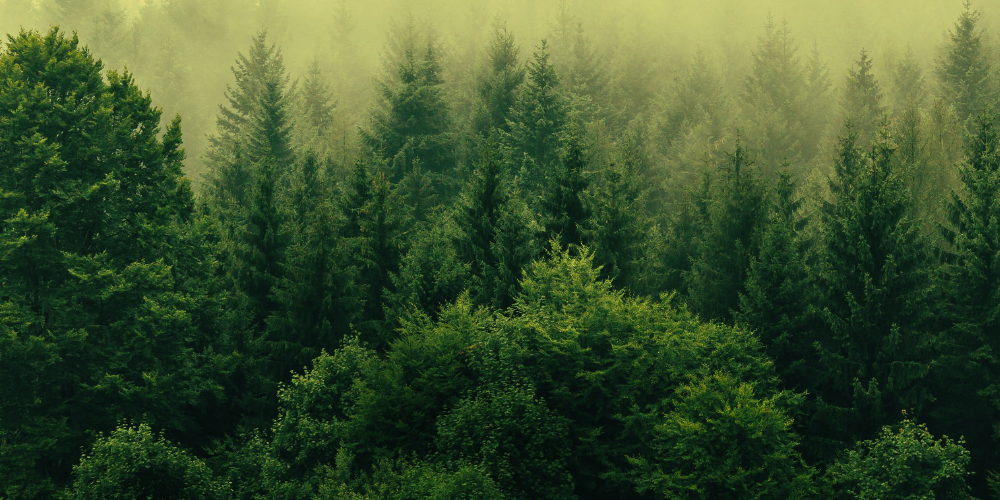
‘Nothing has ever been said about God that hasn’t already been said better by the wind in the pine trees,’ said the great twentieth-century Trappist monk and writer, Thomas Merton.
I think those words point beautifully to something many of us will have experienced: moments in the natural world when we seem to touch something that words cannot quite contain, but can only point towards.
Jane Goodall, the pioneering conservationist and lifelong advocate for the natural world, who died this time last year, described something very similar when she reflected on her early years living and working among the chimpanzees of Gombe. She hadn’t gone there in search of a spiritual experience. She had gone there to work. And yet, as she became more deeply immersed in the life of the forest, something began to change in her. She wrote:
‘I became totally absorbed into this forest existence. It was an unparalleled period when aloneness was a way of life; a perfect opportunity, it might seem, for meditating on the meaning of existence and my role in it all. But I was far too busy learning about the chimpanzees’ lives to worry about the meaning of my own.
I had gone to Gombe to accomplish a specific goal, not to pursue my early preoccupation with philosophy and religion. Nevertheless, those months at Gombe helped to shape the person I am today. I would have been insensitive indeed if the wonder and the endless fascination of my new world had not had a major impact on my thinking. All the time I was getting closer to animals and nature, and as a result, closer to myself and more and more in tune with the spiritual power that I felt all around.
For those who have experienced the joy of being alone with nature there is really little need for me to say much more; for those who have not, no words of mine can even describe the powerful, almost mystical knowledge of beauty and eternity that come, suddenly, and all unexpected. The beauty was always there, but moments of true awareness were rare.
They would come, unannounced; perhaps when I was watching the pale flush preceding dawn; or looking up through the rustling leaves of some giant forest tree into the greens and browns and the black shadows and the occasionally ensured bright fleck of blue sky; or when I stood, as darkness fell, with one hand on the still warm trunk of a tree and looked at the sparkling of an early moon on the never still, softly sighing water of Lake Tanganyika.’ (1)
‘The beauty was always there, but moments of true awareness were rare…’ I love those words. The contemplative life might be described as a life of becoming more and more available to those moments of simple, uncluttered awareness. Learning to see what is right here, in this moment. Learning to listen to what is being said to us, in this moment.
Reading the Love Letter of Creation
Writing in the fourth century to his spiritual mentor, St Melania the Elder, the great desert monastic Evagrius describes creation as a letter from God.
A letter, says Evagrius, is a vehicle for making known to another person ‘those intentions and hidden secrets that are not for everyone and are not to be revealed to anyone except those who have a kindred mind’.
I’d like to highlight two things Evagrius says about creation as a letter from God. First, the message that the ‘letter of creation’ conveys is that God loves creatures and will communicate with them. Second, the very way that the letter is composed is itself instructive. As Evagrius puts it: ‘In reading a letter, one becomes aware through its beauty of the power and intelligence of the hand and finger that wrote it, as well as of the intention of the writer; likewise, one who contemplates creation with understanding becomes aware of the Creator’s hand and finger, as well as of his intention – that is, his love.’
In other words, creation is a love letter to us from God. The question for us is, how can we read it? Or how can we allow the writer to speak to us through the letter? Let go of your thoughts and concepts, says Evagrius. (2) Learn to listen, to see beyond your self-generated images and mental noise. Become quiet. Become open. ‘Be still, and know’ (Psalm 46:10).
The Art of Deep Seeing and Listening
Poets have much to teach us about the art of deep seeing and listening. Let me remind you of some guidance given by the 17th-century Japanese master of haiku poetry, Matsuo Basho, to one of his students:
‘Go to the pine if you want to learn about the pine, or to the bamboo if you want to learn about the bamboo. And in doing so, you must leave your subjective preoccupation with yourself. Otherwise, you impose yourself on the object and do not learn. Your poetry flows of its own accord when you and the object have become one – when you have plunged deep enough to see something like a hidden glimmering there. If the object and yourself are separate – then your poetry is not true poetry but merely your subjective counterfeit.’ (3)
Basho encourages his student to encounter creation with self-forgetful, open, receptive attention. True poetry ‘flows’ when we have become ‘one’ with what is before us, when we have plunged deeply enough to sense the ‘hidden glimmering’ there.
Learning to Become Self-Forgetful
‘Deep calls to deep,’ sings the Psalmist (Psalm 42:7). ‘Put out into the deep, and let down your nets for a catch,’ Christ invites us (Luke 5:4). Meditation, our prayer of silence, is all about coming to see clearly, being able to listen deeply.
We learn to recognise how much of what we see and hear is shaped by our own thoughts, our fears and desires, memories and expectations. How easily we become preoccupied with ourselves, looking at the world through the lens of our own concerns, our likes and dislikes, judgements and anxieties. How we see what we wish to see, rather than what is actually before us. How we listen to our endless conversations with ourselves, rather than simply listen.
Meditation is a way of learning to recognise these habits of mind, and to gently press pause on them. As we sit in silence, returning again and again to our prayer word, to our breath, we are learning to release our preoccupation with ourselves. We are learning to be self-forgetful, open and receptive. This is part of the healing work of meditation.
As we become less caught up in our own thoughts and concerns, we come home to the gift of our life. We find ourselves becoming more present, more available. We begin to see more clearly, to listen more deeply.
Meditation as an Act of Care
The word ‘meditation’ can be traced to the Indo-European root ‘med,’ meaning ‘to take appropriate measures,’ and ‘to take care.’
With this in mind, we might understand meditation as an ‘appropriate measure,’ a way of ‘taking care’ of ourselves, so we can come to see clearly and listen deeply. To read the love letter of creation. To hear the writer speaking to us through creation. To realise that we ourselves are part of this letter. To realise that we are not separate from creation, but belong to the very life we are contemplating.
Learning to Care for the World
As we begin to recognise this, our relationship with the natural world changes. We become less concerned with what we can take from it, or how it might serve our purposes, and more attentive to the life that is before us, more concerned with what we can offer. We begin to see what is so easy to overlook. To recognise the beauty, the goodness, and also the vulnerability of the life we share. And with this growing awareness comes a greater capacity for care. Not because we have been told that we ought to care, but because we are coming to know more deeply what it is that we are caring for, how we belong to it and exist within it.
And so our meditation is both a practice of taking care of ourselves and a way of learning to take care of the world. As we learn to listen more deeply, to see more clearly, to recognise our shared life within the love letter of creation, we become more able to respond with care, with love.

This blog is based on one of the teachings given in a recent online meditation group gathering. You are warmly welcome to join one of our future gatherings.
We use cookies (including Google Analytics and Meta Pixel) to enhance your browsing experience, serve personalised ads or content, and analyse our traffic. By clicking ‘Accept All’, you consent to our use of cookies.