Skip to content
We teach Christian meditation as a spiritual path to peace, community and oneness
  • Practice Community
  • Christian Meditation
  • Events & Retreats
  • Teachings
  • Guides
  • Meditation Timer
  • The Missing Peace book
  • About Us
  • Donate
  • Practice Community
  • Christian Meditation
  • Events & Retreats
  • Teachings
  • Guides
  • Meditation Timer
  • The Missing Peace book
  • About Us
  • Donate
  • Practice Community
  • Christian Meditation
  • Events & Retreats
  • Teachings
  • Guides
  • Timer
  • The Missing Peace book
  • About Us
  • Donate
  • Practice Community
  • Christian Meditation
  • Events & Retreats
  • Teachings
  • Guides
  • Timer
  • The Missing Peace book
  • About Us
  • Donate
Teachings from Contemplative Christianity

Towards a Global Spirituality

Can we belong to different traditions & to one another?

A few weeks ago, I had the privilege of co-leading a retreat with Sister Chan Duc, a senior Buddhist monastic in the Plum Village tradition of Thich Nhat Hanh. The title of the retreat was Towards a Global Spirituality: Buddhist-Christian Wisdom for Inner Peace in a Troubled World. Since then, several organisations have asked me to speak about what a global spirituality might mean, and how we might begin to move towards one.

Some years ago, I was asked to run a workshop on meditation and peace for a group of young adults at the Corrymeela Centre in Northern Ireland. The group included Jews, Muslims, Christians, people of other religious faiths, and a few who say they follow no religious faith.

On my final day as I was waiting for a taxi to take me to the airport, one of the organisers said that the young adults would like to begin the day with some meditation, if I had time. As the taxi was taking rather a while, I did have time. So we sat together in silence again, and afterwards we also had time for some conversation.

One of the young people asked, ‘What would you say that meditation has given you? How does it change the way you see things?’ What immediately came to me was very simple: that my practice has allowed me to see that we belong to one another, that the deepest truth of who we are, of life itself, is relationship, is love.

Just before I left, I warned them that meditation is a deeply radical practice.  It breaks down barriers within us. And it breaks down barriers between us. It allows us to discover that beneath our wonderful particularity, we are more intimately connected than we could ever imagine.

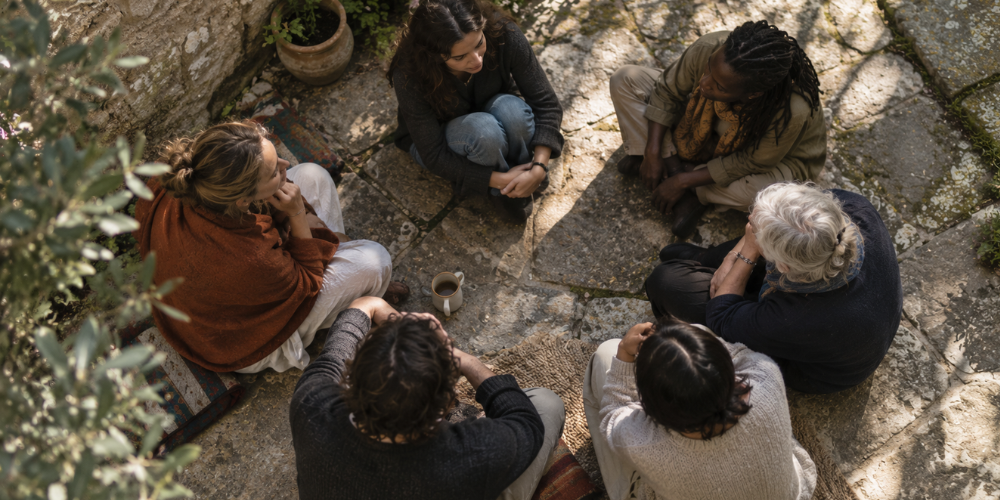
For me, the conversation at Corrymeela pointed towards what a global spirituality might mean, what it might look like, and where it might begin. We were not gathered together to reach agreement about God, or to decide which religion had the most accurate understanding of ultimate reality. We sat together. We breathed together. We met one another simply as human beings. Being silent together, stilling the chattering mind, helped open a space for deeper encounter.

Are we talking about religious sameness?

Some people can be anxious about the idea of a global spirituality, thinking it might involve removing the differences between us, reducing the rich diversity of our traditions to a kind of spiritual sameness. But a global spirituality does not require us to create a new global religion. Nor does it require us to flatten out the differences between traditions.

I am a Christian. My Buddhist friends are Buddhists. My Muslim friends are Muslim. My Jewish friends are Jewish. And many of my friends do not consider themselves to belong to any religious tradition at all. There are differences between our understandings of reality. These differences can be explored with friendship, curiosity and respect. We do not have to resolve them before we can begin to practise living well together.

How can we live well together?

And this, I think, is where we can begin. Not with metaphysics or theological debate. Not by asking everyone to agree a uniform way of speaking about the nature of ultimate reality. But with practice, beginning with the question: ‘How can we live well together?’ How can we take care of ourselves, so we can take care of each other? How can we respond to suffering? How can we learn to live without violence? How can we cultivate compassion? How can we become people of peace?

The Dalai Lama has spent many years speaking about the possibility of an ethics grounded in our shared humanity. He points out that the great religious traditions have very different philosophies and very different understandings of reality, but they teach some remarkably similar values and ways of living: love, compassion, forgiveness, tolerance, patience, self-discipline. These are not Buddhist values, or Jewish, Muslim or Hindu values, or Christian values. They are not the property of any tradition. They are human values.

Thich Nhat Hanh approached this in a particularly clear and practical way. In the Plum Village tradition, the Five Mindfulness Trainings are described as ‘the Buddhist vision for a global spirituality and ethic.’ They concern very ordinary things. Taking care of life. Generosity and justice. Responsible relationships. Loving speech and deep listening. Mindful consumption. In other words, spirituality is inseparable from how we live. Our daily life is where it becomes embodied. How we speak to one another. How we listen. What we consume. How we respond when we are angry. How we take care of our suffering. How we take care of the suffering of another person. How we learn not to add violence to violence.

This has deep resonances with the Christian tradition. Jesus does not simply give his disciples a collection of propositions to believe, but teaches a way of life. Love God. Love your neighbour as yourself. Love your enemies. Forgive. Do not try and judge the worth of another person. Bless those who persecute you. Feed the hungry. Visit the sick and the prisoner. Become peacemakers.

The fruit of the Spirit described by St Paul are similarly practical: love, joy, peace, patience, kindness, generosity, faithfulness, gentleness and self-control. These are all practices, ways of being. Christian ethics is not primarily about obeying a set of rules. It is about learning to live from the deepest truth of who we are, which is God. It is about our lives becoming the likeness of God who is love-in-relationship. It is, ultimately, about learning to be human.

When Paul speaks about the fruit of the Spirit, the image is organic. Fruit grows. It develops when it is tended. The virtues are not simply things we do. They become qualities of being. Our practice helps us cultivate these qualities so that they increasingly permeate our lives and become the way we live.

This is an important meeting point between spiritual traditions. Whatever our differences, we can recognise together the importance of becoming less governed by anger, fear, greed and self-interest, and of cultivating compassion, patience, generosity, peace and love.

I think this is fundamental to any movement towards a global spirituality. We begin with the practice of living well together. But ethics alone is not enough, because we very quickly discover that knowing how we want to live and actually living that way are two different things. We may believe deeply in peace and still become angry. We may believe in compassion and find ourselves judging someone. We may believe in forgiveness and discover resentment within us that we cannot simply think away. We may sincerely want to listen and find that while another person is speaking we are already preparing our reply. We may reject violence in the world while discovering the seeds of violence within ourselves.

From inner peace comes outer peace

And this is where meditation becomes so important. Meditation helps us to see what is happening within us. We begin to recognise our habits. Our conditioning. Our patterns of thought and reaction. The seeds of fear. The seeds of anger. The seeds of judgement, violence and conflict. And we learn to meet them, to take care of them, so that we do not water them and allow them to grow. At the same time, we learn to recognise and cultivate the seeds of peace, compassion, patience and love.

This is why ethics and meditation belong together. Ethics gives direction to our practice. Meditation creates the inner space in which we become able to live what we value. We learn to see anger before anger becomes speech. We learn to recognise fear before fear determines our behaviour. We begin to notice the thought before we become completely identified with the thought. A space opens in which we have greater freedom to respond wisely and compassionately. The insight, patience and resolve that we learn in meditation help sustain a life of peaceful, compassionate action. To put it very simply, greater interior peace gives birth to greater exterior peace.

The universal language of silence

And there is another dimension to meditation which I think is particularly important when we speak about a global spirituality. Silence is a universal language. Before we seek to explain ourselves to one another, before we compare our beliefs, before we defend our traditions, we can be silent together. We can sit together. We can breathe together. There is something profoundly equalising, profoundly unifying about this. For a little while nobody needs to persuade anyone else of anything. Nobody needs to win an argument. Nobody needs to have the correct theological vocabulary. We meet simply in the vulnerability and dignity of being human.

Meditation, the prayer of silence, clears a space for deeper encounter, for meeting one another at the depth our being. In this way, meditation helps build community. Opening ourselves to the depth-dimension of life, our capacity to listen deeply and speak peacefully, lovingly, grows.

Laying a new foundation

This is why I think the movement towards a global spirituality is actually very simple. It begins with practice: ethics and meditation.

Learning to take care of ourselves. Learning to take care of one another. Learning to live without causing unnecessary harm. Learning to recognise the seeds of violence and conflict within ourselves and to cultivate kindness, generosity, forgiveness, deep listening, peace and compassion. Sitting together in silence, we can begin very gently, very simply. We can practice laying a new foundation for a new future, together.


In the sayings of the Desert Fathers and Mothers, Abba Moses asks Abba Silvanus: ‘Can a person lay a new foundation every day?’ Abba Silvanus replies: ‘If one works hard, one can lay a new foundation at every moment.’ This is what we practise in meditation. At every moment, a new foundation. At every moment, the possibility of beginning again. The possibility of growing together, of laying the foundations of peace, of compassion, of love. And we can practise this anywhere. Walking along the street. Waiting in a supermarket queue. Sitting on a bus. In a difficult meeting at work. In the middle of an argument at home.

A global spirituality will not be created by agreeing on a universal metaphysics or theology. It will grow as we learn to live together with greater wisdom and compassion. As we learn to recognise and take care of the violence within ourselves. As we learn to listen and cultivate greater peace within ourselves. As we learn to love.

As we learn to sit together in silence, we discover, beneath all our wonderful differences, how deeply our lives belong to one another. We come to recognise that we are one body.

This blog is based on one of the teachings given in a recent online meditation group gathering. You are warmly welcome to join one of our future gatherings.

free sign up
PrevPreviousThe View from Above
NextCreation:Next

“The School of Contemplative Life has rapidly become my spiritual home.”

“I am feeling that I am coming to truth – and the peace that accompanies that sense of being.” 

“Since meditating, I am much more likely to see things and appreciate things as Sacred.”

CONTACT

  • +44 (0) 7834 626426
  • [email protected]
  • Safeguarding Policy
  • Participant Code of Conduct
  • Website Terms and Conditions
  • Event Terms and Conditions
  • Bursary Guidelines
  • Privacy Notice
  • Charity reg no
Email us

Mailing list sign up​

Receive our quarterly newsletter and other occasional mailings.

Connect

Connect with us via Facebook, Instagram and Insight Timer.

 
Facebook Instagram Youtube

online meditation

A quiet space awaits—free online meditation, twice a week, everyone is welcome.

REGISTER NOW

Managed by DevEdge

Manage Consent

We use cookies (including Google Analytics and Meta Pixel) to enhance your browsing experience, serve personalised ads or content, and analyse our traffic. By clicking ‘Accept All’, you consent to our use of cookies.

Functional Always active
The technical storage or access is strictly necessary for the legitimate purpose of enabling the use of a specific service explicitly requested by the subscriber or user, or for the sole purpose of carrying out the transmission of a communication over an electronic communications network.
Preferences
The technical storage or access is necessary for the legitimate purpose of storing preferences that are not requested by the subscriber or user.
Statistics
The technical storage or access that is used exclusively for statistical purposes. The technical storage or access that is used exclusively for anonymous statistical purposes. Without a subpoena, voluntary compliance on the part of your Internet Service Provider, or additional records from a third party, information stored or retrieved for this purpose alone cannot usually be used to identify you.
Marketing
The technical storage or access is required to create user profiles to send advertising, or to track the user on a website or across several websites for similar marketing purposes.
  • Manage options
  • Manage services
  • Manage {vendor_count} vendors
  • Read more about these purposes
View preferences
  • {title}
  • {title}
  • {title}